


A featured contribution from Leadership Perspectives: a curated forum reserved for leaders nominated by our subscribers and vetted by our MarTech Outlook Advisory Board.

Swiss Re
Structure and Balance: Strategy for Agile Marketers

Arnaud Barthelemy
I’ve always loved strategic work, but in my early career overestimated what doing strategic work actually required, making it more complex than it needed to be. Then, thirteen years ago,my mentor and former manager simplified strategy for me: Strategy is only about finding a way to go from point A to point B. And there is more than one way to get there.
In this article, I share some of the learnings I gathered during my journey as a marketing leader that can hopefully help you to simplify your own strategic planning,build your objectives, frame your work, and prioritize it.
Short-term vs Long-term vs the Unknown: Finding Balance
A typical strategic planning process is a three-to-five-yearexercise that most companies go through, regardless of their size or industry. As a marketer, however, we are usually expected to report resultson a quarterly or monthly basis, and I’ve even done weekly reporting.
The balance between long-term and short-term focus is hard to find. On top of that, serious market disruptors happen at a faster pace than your planning process and they can throw your plan away.
Just look at the last three years: multiple COVID waves and lockdowns, social justice issues in the US, the war in Ukraine, etc. And that does not include industry or company specific issues.
Whose marketing plan has not totally been disrupted by these?
When building your marketing strategy, keep potential disruptors in mind, because in the end one of the few certainties you have at the beginning of your fiscal year is thatsh*t will happen.
You just don't know how, when, or where, but it will.
The 30-60-10 Formula
If your marketing strategy relies too much on long-term efforts, you might find yourself finding excuses on a quarterly basis rather than showing tangible results. Your strategy should incorporate a good blend of short or opportunistic activities and long-term vision effort.
“Strategy is a big word that is used and overused in the corporate world. At the end of the day, we all strategize to a certain degree”
As a general rule, I go with the 30-60-10 formula:
• 30% of your efforts support long-term initiatives
• 60% are for short to medium-term activities
•10% for surprises
I discovered this type of allocation allows for enough flexibility when things change drastically, without compromising the delivery of tangible results.
The underlying philosophy is that our role as marketers is to support the business by having a direct or indirect - yet measurable - impact on revenues, not to deliver on a pre-determined plan, regardless of the conditions. Business is not steady, it fluctuates, it is c
omposed of big trends and short-term threats and opportunities, internal and external.
Leverage the scientific method
According to Britannica, the scientific method is a technique used in the construction and testing of a scientific hypothesis. The idea is that based on your initial observation, you build a hypothesis which you will then challenge through testing. By observing the results of that test, you will then adjust your hypothesis. And repeat again and again until your hypothesis becomes true.
Marketing should follow the same method. Because the market is full of unknowns and can sometimes be illogical in its reactions, it is almost impossible to come up with the right formula the first time.
The scientific method is the best way to optimize your resources, especially if you are moving into a new area (new product or new audience). You take small steps toward your objective and gather additional data in order to refine your hypothesis.
Frameworks Make the Dream work: How to frame and plan your work
Whether you’re creative, analytical, or both, one thing that you should always use to build your strategy is a framework. And here again, you have several to choose from that will best fit your team.
The Objectives Key Results (OKR) Framework
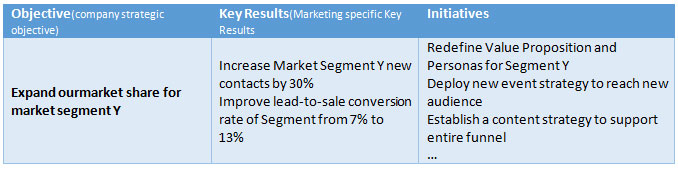
One that I like to use is the OKR framework. OKR actually hasthree categories, the last one being Initiatives.What I love about this framework is that it allows you to put the emphasis on what you want to achieve and how you will measure your success. Agreeing on the objective and what metrics you will influence is key! And for your own team, this serves as a perfect north star, helping them to make decisions daily on doing or not doing something. When a request comes in to your team, they can ask themselves: Does this support our objective? Will it positively impact metrics?
Analyze-Identify-Plan
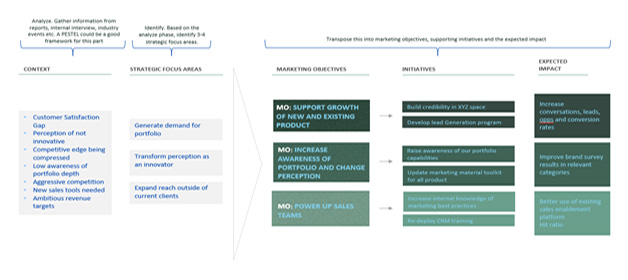
Another popular framework is Analyze-Identify-Plan. This is a classic framework and probably one of the most used under various formats. I am not a huge fan of this one as it can quickly become draining, especially the analyzing part. Again, your company's setup and culture will help you choose the right When reporting on your progress, don't forget to always use your framework and update the impact section. It will make your storytelling much easier.
Prioritizing: How toAccount for Shifting Priorities
How many of us have heard or said, "with priorities shifting constantly, I don't know where to focus!"? Well, priorities do not change. Initiatives do. And an initiative is NOT a priority, the expected outcome is a priority. So, it does not matter if the activity changes, what matters is the outcome or contribution to the goal.
I use a statistical tool to help my team prioritize requests and projects that are not planned.
The idea is simple: weigh your objectives and evaluate each initiative against them. The tool will remove any subjectivity in your assessment of which initiative should move forward. Here’s how:
• List your strategic objectives.
• Give them a weight (they are not all equal) from 1 to 3.
Now for each of the conflicting initiatives, give them a rating – basically how would they contribute to the objective. Give them a note from 1 to 5 with5 being the highest contribution. Once you are done populating the table, compare the results. The highest number wins because it should have the biggest impact on achieving your goals.
Here is an example:
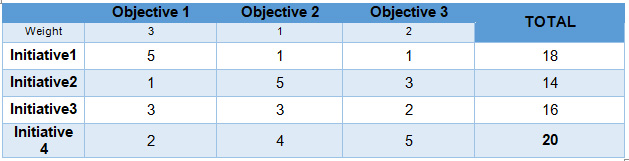
To get the total number of Initiative 1: (5x3)+(1*1)+(1*2)= 18
Prioritization is a challenge everyone faces, and even experienced professionals struggle with it. The problem with priorities is subjectivity in the assessment. If you want to make the right call on what to say yes or no to, you need to remove subjectivity and have an objective look at how the initiative is contributing to the goal.
In Conclusion
Strategy is a big word that is used and overused in the corporate world. At the end of the day, we all strategize to a certain de
gree. We need to go from point A to point B in a certain amount of time and with a certain amount of resources. As a leader, I love strategic work as it is a way to demonstrate the value we bring as marketers to other departments, and it is also something that helped my teams navigate uncertainty and those famous "shifting" priorities.
