


A featured contribution from Leadership Perspectives: a curated forum reserved for leaders nominated by our subscribers and vetted by our MarTech Outlook Advisory Board.

Alphaland
Events as Accelerators: Measuring Pipeline Velocity Over Volume

Kristine Cortes
Kristine Cortes is Vice President for Event Sales at Alphaland Development's Balesin in Metro Manila. With 15 plus years in sales, marketing, and event management, she holds a Bachelor's in Advertising and Public Relations from Assumption College. Creative and detail-oriented, she excels in hospitality events and team logistics.
In an exclusive interview with MarTech Outlook APAC, she shared invaluable insights on on how events accelerate pipeline velocity, foster authenticity, and transform stalled prospects into revenue.
The Velocity Advantage: Why Speed Outperforms Size
In the high-stakes B2B landscape of the Asia-Pacific region, the traditional "spray and pray" approach to event marketing is demonstrably losing effectiveness. For contemporary revenue leaders, the true objective is no longer the sheer volume of leads generated, but rather Pipeline Velocity, the quantifiable speed at which an event progresses a prospect from initial interest to committed investment. By strategically shifting the focus from top-of-funnel volume to mid-funnel acceleration, leaders are positioned to transform events from a mere cost center into a high-performance revenue engine.
To fully comprehend the value proposition of event-driven acceleration, we must thoroughly examine the Pipeline Velocity Equation. Revenue leaders are frequently pressured to increase "Volume," yet mathematical reality demonstrates that "Velocity" is a substantially more potent lever for sustained growth.
V = Qualified Opportunities X Average Deal Value X Win Rate %
Length of Sales Cycle [Days]
Consider the following comparative analysis of two regional sales strategies:
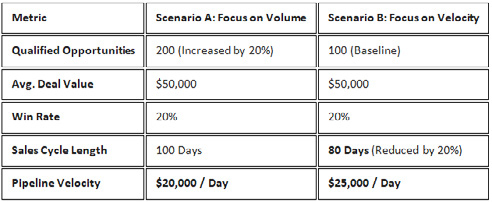 As the data illustrate, Scenario B generates 25percent more revenue per diem than Scenario A. By strategically using events to unblock deals and reduce the sales cycle by 20 days, a firm can significantly outperform a competitor whose primary focus is simply on registering more attendees.
The "Authenticity Premium" in the Age of AI
In the year 2026, the market is characterized by a pervasive "trust deficit." With AI agents now capable of simulating personalized outreach at scale, B2B buyers have developed a highly discerning filter for digital communication. In this new commercial landscape, in-person events have emerged as the paramount proof of authenticity.
Specifically within the APAC region, where cultivating personal relationships is the fundamental basis of commerce, the physical event remains the only setting where a prospect can fully verify the human expertise underlying machine-generated content. Events function as a signal filter; while the marginal cost of a digital touchpoint has approached zero, the marginal value of a physical interaction has never been greater.
Bridging the Gap: Transitioning From Marketing Function to Sales Engine
The most frequent cause for events failing to deliver measurable Return on Investment is a fundamental lack of upstream alignment. To effectively drive velocity, Marketing must conceptualize the event, and Sales must systematically leverage it.
"Events accelerate revenue not by sheer lead volume but by compressing sales cycles, turning stalled prospects into committed investments through authenticity, alignment, and velocity."
1. Co-Authored Attendee Lists: Comprising 40percent New Prospects, 40percent Stalled Deals (for targeted Acceleration), and 20percent Existing Satisfied Customers (for Social Proof).
2. The Efficacy of the Mixed Table: Strategically seating stalled prospects adjacent to existing clients establishes a peer-validation environment. In high-context markets such as Japan or Australia, hearing a client articulate their successful navigation of a challenge serves as the definitive unblocking mechanism.
3. Multi-threading Engagement: Events afford a unique opportunity to engage the entire "buying committee" including CFOs, end-users, and technical gatekeepers simultaneously, thereby compressing what would typically be months of individual sales calls into a single structured afternoon.
Technical Framework: Unified Attribution
Without Unified Attribution, the ROI of an event remains practically unquantifiable. Most Customer Relationship Management (CRM) systems default to "First-Touch" or "Last-Touch" models, yet acceleration necessitates Influence Attribution. Unified Attribution considers the event as a "heavyweight" touchpoint. By assigning a demonstrably higher weight to in-person interactions in the "Mid-Funnel," platforms can award "Acceleration Credit" to events that facilitate a deal's progression from a stalled state to the closing phase. This protocol ensures that even if an event did not source the initial lead, it is appropriately recognized as the pivotal factor in the revenue timeline.
Strategic Alignment: The Path Forward
Alignment must be viewed as a pre-event discipline, not merely a post-event autopsy. It mandates:
• Shared Velocity Dashboards: Enabling real-time tracking of "Account Movement" across all regional hubs.
• The 48-Hour Feedback Loop: A compulsory post-event debrief to capture qualitative intelligence (e.g., nuanced regional competitor shifts) that quantitative data alone may fail to identify.
When marketing and sales uniformly adopt the lexicon of velocity, events undergo a fundamental transformation. They cease to be merely venues for meeting new individuals; they become the most effective tool in the operational arsenal for significantly reducing the time between a "First Touch" and a "Final Signature."
Executive Summary
• Key Performance Indicator Shift: Transition the core metric from Lead Volume to Sales Cycle Delta.
• Targeted Mid-Funnel Strategy: Utilize events specifically to expedite deals that have been stalled for 45 or more days.
• The 2026 Mandate: Leverage Artificial Intelligence to automate routine tasks while deploying physical events to facilitate high-value, meaningful human engagement.
• Regional Nuance: Capitalize on local client advocates to build critical trust in "High-Context" Asia-Pacific markets.
